![Bangladesh Should Help Shape Global Internet Standards, Not Just Adopt Them: Dhruv Dhody]()
Mohammad Kawsar Uddin
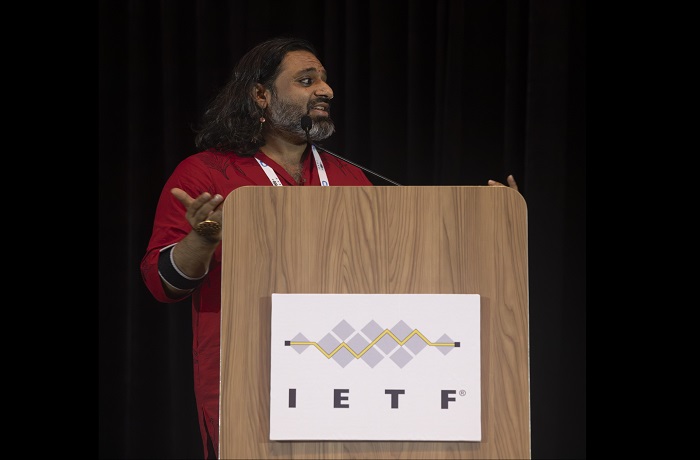
The Internet’s future depends not only on faster networks and artificial intelligence, but also on open technical standards that keep the global network secure, reliable and interoperable. Dhruv Dhody, an Internet standardisation expert at Huawei India and one of the leading contributors to the global Internet standards community, has more than two decades of experience in networking technologies.
Dhruv currently serves as Chair of the Internet Architecture Board (IAB) and co-chairs the Internet Engineering Task Force (IETF)’s Path Computation Element (PCE) and SRv6 Operations (SRv6OPS) working groups (WG). A strong advocate for diversity and inclusion, he is also working to increase participation from the Asia-Pacific region in the IETF.
In this exclusive interview with Mohammad Kawsar Uddin, Dhody shares their insights on Internet standards, governance, cybersecurity and digital inclusion, while highlighting opportunities for Bangladesh to engage more actively in the global Internet ecosystem and help shape its future.
Question: What Internet standards should Bangladesh prioritize to build a stronger digital future?
Answer: Bangladesh should prioritize IPv6, routing and Domain Name System (DNS) security, and modern transport and security protocols as foundation for a stronger and more resilient digital future.
IPv6 is essential to support the continued growth in Internet users, services and connected devices in Bangladesh. It can reduce dependence on increasingly complex mechanisms for sharing limited IPv4 addresses.
Routing security and DNSSEC can strengthen trust in the Internet by helping operators detect unauthorized route announcements and verify that DNS information has not been manipulated. Modern transport and security protocols can further improve network performance, reliability and end-to-end protection.
Bangladesh should also prepare for emerging challenges involving AI agents and digital identity, where open standards will be important so that different systems can interoperate while supporting secure authentication, data protection, delegated authority and accountability.
Most importantly, Bangladesh should not remain only a technology adopter. Bangladeshi engineers, network operators, universities and technology companies should actively participate in the IETF and contribute local expertise and practical experience in areas such as large-scale connectivity, affordability, mobile-first access and linguistic diversity. This will allow Bangladesh to help shape the Internet standards’ future.
Question: How can more Bangladeshi engineers and students participate in the IETF and global standards development?
Answer: Bangladeshi engineers and students should understand that the IETF is not just a conference held three times a year. Much of its work takes place throughout the year through mailing lists, document reviews, research, implementation and testing.
Attending an IETF meeting can be a useful starting point, but sustained participation requires institutional support. Bangladeshi operators should give engineers time and resources to contribute, while universities can support research, measurements, implementations and collaborative projects with industry.
A practical way to begin is by addressing real local challenges, such as IPv6 deployment, Resource Public Key Infrastructure (RPKI) validation, routing measurements and transport security. Contributions based on operational data, implementation experience and testing can provide valuable evidence for standards development.
Regional experts and the Bangladeshi diaspora can also help newcomers connect with the global standards community. Initiatives such as India Internet Engineering Society (IIESoc) in India offer useful regional experience and networks.
Ultimately, Bangladesh needs to develop its own sustained community of Internet standards contributors who can bring local expertise and challenges to the global IETF process.
Question: What role will Internet standards play in Bangladesh’s 5G, AI, and smart-city ambitions?
Answer: Internet standards will be fundamental to Bangladesh’s ambitions in 5G, AI, cloud computing and smart cities. Although these technologies are often discussed separately, they depend on the same underlying Internet Infrastructure such as addressing, routing, naming, secure communications, identity and reliable data exchange.
Open standards enable technologies and services from different vendors and organizations to work together. They can also reduce dependence on proprietary ecosystems, encouraging interoperability, competition and innovation.
This becomes even more important with agentic AI, where AI systems may act on behalf of people, access services and data, communicate with other agents, and make decisions with real-world consequences. Standards will be needed to establish an agent’s identity, define delegated authority, protect data, limit and audit actions, and revoke permissions when necessary.
The technical solutions are still evolving. Bangladesh should actively contribute to this process rather than simply wait for standards developed elsewhere. Bangladeshi researchers, engineers, universities and technology companies can bring local experience and challenges to global standards discussions, helping build a secure, interoperable and accountable digital future.
Question: What can Bangladesh learn from global best practices in Internet governance?
Answer: Bangladesh can learn that effective Internet governance must be based on openness, transparency and meaningful participation. Governments have an important role, but operators, technical experts, universities, civil society, businesses, journalists and users should also have a voice. Public consultation is meaningful when stakeholders can understand how their input influenced decisions.
Internet resilience is not only about cables, networks and data centres; it also depends on sound governance. Internet shutdowns should face a very high threshold and must be lawful, necessary, proportionate, transparent, limited in scope and duration, and subject to independent review.
This is a broader South Asian challenge, not just a Bangladesh issue. As economies increasingly depend on digital connectivity, shutdowns can disrupt digital payments, businesses, education, healthcare, transport, emergency communications, journalism and access to reliable information. They can also make it harder for citizens to verify rumours and for authorities to communicate accurate guidance.
Bangladesh should therefore protect reliable connectivity while strengthening multistakeholder Internet governance, ensuring that digital transformation is supported by trust, accountability and resilience.
Question: What are the biggest cybersecurity challenges Bangladesh should prepare for?
Answer: One of Bangladesh’s biggest cybersecurity challenges is failing to keep pace with current security and operational best practices. Cybersecurity is not a one-time investment; systems must be continuously maintained, patched, monitored and tested, while routing and naming infrastructure must be protected and incident-response plans regularly exercised.
Bangladesh should also prepare for emerging risks such as post-quantum cryptography (PQC). Organisations need to identify where and what cryptography is used, which sensitive information must remain protected for many years, and which systems may be difficult to upgrade. Building crypto-agility—the ability to replace cryptographic algorithms when necessary—will be increasingly important.
Most importantly, Bangladesh needs a strong and coordinated cybersecurity ecosystem. Government agencies, telecom operators, banks, IXPs, universities, technology companies, researchers and incident-response teams should build trusted relationships to share information, conduct joint exercises, responsibly disclose vulnerabilities and coordinate during cyber incidents.
The strength of these partnerships before a crisis often determines how effectively a country can respond when one occurs.
Question: How can Bangladesh increase the participation of women and young professionals in Internet standards work?
Answer: Bangladesh can increase women’s and young professionals’ participation in Internet standards work by creating strong professional networks, mentoring opportunities and sustained technical engagement.
The IETF Systers Program is a useful example, providing women and nonbinary participants with opportunities to exchange experiences, build connections, support newcomers and develop leadership skills. Bangladeshi women entering the IETF should be encouraged to join such international networks while also building local connections through universities, network operators, technical organizations and experienced professionals.
Participation should go beyond simply attending IETF meetings. Newcomers need a clear pathway—from introductory sessions to following technical discussions, reviewing documents, testing implementations, conducting research and eventually contributing to standards development.
Post Views: 437



Comments (0)
Leave a comment
আপনার ই-মেইল এ্যাড্রেস প্রকাশিত হবে না। * চিহ্নিত বিষয়গুলো আবশ্যক।