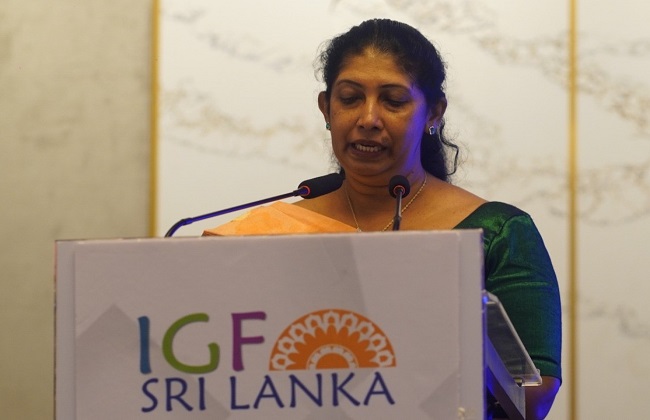
![Build Networks, Build Human Capacity: Sagarika Wickramasekera]()
Mohammad Kawsar Uddin
Sagarika Wickramasekera, Member of the Internet Society Board of Trustees, is a Sri Lankan network engineer and Internet governance advocate with more than two decades of experience in networking, IT and digital inclusion.
An Assistant Network Manager at the University of Colombo, she is a former President of the Internet Society Sri Lanka Chapter and a founding member of the Lanka School of Internet Governance and Lanka Network Operators Group. She has also been closely involved in initiatives promoting women’s participation, digital accessibility and the inclusion of persons with disabilities and underserved communities.
Wickramasekera is President of the Asia Pacific School of Internet Governance (APSIG) and serves on the Executive Committee of the Asia Pacific Next Generation Group (APNG).
In this interview Mohammad Kawsar Uddin, she shares her perspectives on what Bangladesh can learn from Sri Lanka, closing the digital divide, empowering women and persons with disabilities, strengthening Bangladesh’s role in Internet governance and balancing AI innovation with digital rights, cybersecurity and an open Internet.
Question: What can Bangladesh learn from Sri Lanka and other Asia-Pacific countries in building a more inclusive digital society?
Answer: From my experience, one of the most important lessons is that digital inclusion cannot be achieved through infrastructure alone. I have spent much of my career as a network engineer, building and managing networks, so I understand the importance of connectivity. But connecting people to the Internet does not automatically mean they are digitally included.
During my involvement with the Internet Society Sri Lanka Chapter, we worked with communities with different levels of access and digital literacy. Through initiatives such as Beyond the Reach, we supported people with visual impairments in using the Internet and digital technologies. I also contributed to ICT training for persons with disabilities, including disabled military personnel. These experiences taught me that digital inclusion means enabling people to use technology meaningfully, independently and with dignity.
Bangladesh can build on its achievements by putting communities at the centre of digital development. Sri Lanka and Bangladesh can learn from each other, particularly on rural access, affordability, women’s participation and accessibility.The lesson is simple: build the network, but also build the human capacity to use it.
Question: What should Bangladesh prioritise to close its digital divide, particularly for women, people with disabilities and rural communities?
Answer: I would prioritise affordable connectivity, digital skills, accessibility and meaningful participation.
Having worked in networking for more than two decades, I have seen how connectivity can transform education, employment and access to information. But connectivity alone is not enough. If Internet access is expensive, people lack suitable devices, or digital services are inaccessible, the network cannot fully bridge the digital divide.
For rural communities, Bangladesh needs affordable and reliable last-mile connectivity, supported by community-based digital literacy programmes. For women, we should move beyond basic computer training and create pathways into advanced fields such as network engineering, cybersecurity, cloud computing and AI.
For persons with disabilities, accessibility should be built into digital services from the beginning. Government platforms, education systems and financial services should follow recognised accessibility standards and be tested with people with disabilities.
My experience with Beyond the Reach reinforced an important principle: digital inclusion programmes should not be designed for communities without involving those communities in designing the solutions. Their experiences and needs must shape the technology and policies intended to serve them.
Question. What are the Internet Society's key priorities for the Asia-Pacific region in the coming years?
Answer: From my perspective as an Internet Society Board Trustee and someone involved in Asia-Pacific Internet governance, the priority should remain an open, globally connected, secure and trustworthy Internet that works for everyone.
For the Asia-Pacific region, I see four key priorities. First is meaningful connectivity—not simply measuring how many people are connected, but whether they have affordable, reliable and useful access.
Second is Internet resilience and security. As a network engineer, I know that an open Internet depends on strong infrastructure, operational security and resilient networks.
Third is digital inclusion. Women, persons with disabilities, rural communities and other underrepresented groups need both access to technology and a meaningful voice in shaping the Internet.
Finally, we need stronger Internet governance capacity in developing countries. Through APSIG, APNG, LkSIG and other initiatives, I have seen the importance of developing local expertise and leadership so Asia-Pacific countries can contribute effectively to global Internet policy discussions.
For me, the Internet Society’s mission goes beyond connecting networks. It is about ensuring that the Internet continues to serve people and communities.
Question: How can APAC countries balance AI innovation with digital rights, cybersecurity and an open Internet?
Answer: We should not see AI innovation and digital rights as opposing objectives. The way forward is responsible innovation that protects people while enabling technological progress.
AI can create significant opportunities for developing countries in education, healthcare, agriculture, public administration and economic development. However, without safeguards for privacy, cybersecurity, bias, accessibility and accountability, AI could create new forms of digital exclusion.
My background in networking has made me particularly conscious of the importance of security by design. The same principle should apply to AI. Security, privacy and human rights should not be addressed only after a system is deployed; they must be considered from the beginning.
At the same time, policymakers should avoid unnecessary restrictions that could fragment the Internet, weaken open standards or undermine encryption.
APAC countries should therefore cooperate on responsible AI, cybersecurity, data protection and digital rights, while ensuring that developing countries have a meaningful voice in shaping the rules.
Ultimately, innovation should strengthen an Internet that is open, secure, inclusive and trustworthy, rather than creating new barriers to participation.
Question: Why does women's participation in technology remain low, and what can Bangladesh do to change this?
Answer: This is an issue very close to my own experience. When I entered the networking profession, there were very few women in technical networking roles in Sri Lanka. I was among a small number of female network engineers at the time. My experience showed me that women can succeed in highly technical careers, but the ecosystem does not always encourage them to enter, remain or advance in those fields.
The challenge often begins early, when girls may receive less encouragement to pursue engineering and technology. Even women with technical qualifications can face workplace stereotypes, limited mentoring, unequal opportunities and barriers to career advancement.
Bangladesh should therefore build a complete pipeline: education → technical training → internship → employment → mentoring → leadership.
I would particularly encourage investment in women in advanced fields such as network engineering, cybersecurity, cloud computing and AI, rather than limiting digital programmes to basic ICT skills.
My experience organising women’s Internet governance initiatives, including Sri Lanka’s first Women’s IGF in 2017, has reinforced one important lesson: women need not only training and opportunities, but also a seat at the table where technology decisions are made.
Question: What practical steps can Bangladesh take to make its digital services more accessible to persons with disabilities?
Answer: My answer is simple: make accessibility a requirement, not an afterthought.I have worked directly with persons with disabilities through digital literacy and Internet governance programmes, including an APSIG accessibility initiative in Dhaka that brought together participants from Bangladesh and other Asia-Pacific countries. These experiences showed me the importance of involving people with disabilities in shaping digital solutions.
Bangladesh can take several practical steps. Accessibility should be mandatory in government digital procurement, and websites and applications should follow recognised accessibility standards. Digital services should work with screen readers and other assistive technologies, while providing captions, transcripts, alternative text and accessible documents. Services should also support keyboard and alternative input devices and provide information in Bengali and other appropriate formats.
Developers and government officials should receive accessibility training, but the most important step is to involve persons with disabilities in designing and testing digital services.
I strongly believe in the principle “Nothing about us without us.” People with disabilities should not simply be beneficiaries of digital policy; they should help shape it. APSIG’s accessibility work has reinforced the value of digital literacy, advocacy and capacity building in giving these communities a stronger voice in Internet governance.
Question: How can Bangladesh strengthen its voice and participation in regional and global Internet governance?
Answer: Bangladesh already has capable technical professionals and an active Internet community. The next step is to turn that expertise into sustained participation and leadership in regional and global Internet governance.
My own journey taught me that Internet governance goes beyond technology. I began with a technical networking background, but through my involvement in Internet governance, I learned that decisions about networks, data, privacy, security and access are also closely connected to policy and human rights.
Bangladesh should invest in young Internet governance leaders, particularly women, persons with disabilities and people from outside Dhaka. Building this diverse leadership base will help ensure that different perspectives are represented in policy discussions.
The country should also strengthen its national Internet governance dialogue and encourage experts to participate consistently in regional and global forums—not simply as attendees, but as researchers, speakers, working-group contributors and leaders.
My experience with APSIG has shown me the value of bringing different countries and stakeholder groups together. The Dhaka accessibility workshop demonstrated how Bangladesh can contribute to regional capacity building for a more inclusive Internet governance ecosystem.
Question: What role can Bangladesh and Sri Lanka play in shaping a more open, secure and inclusive Internet for the Asia-Pacific region?
Answer: I believe Bangladesh and Sri Lanka can be stronger together in shaping a more open, secure and inclusive Internet for the Asia-Pacific region. Both countries face similar challenges in developing digital infrastructure while addressing affordability, inclusion, cybersecurity and digital rights. This creates an opportunity to share practical experiences and solutions, rather than simply adopting policies developed elsewhere.
Sri Lanka can contribute its experience in technical networking, Internet governance, accessibility and women’s participation, while Bangladesh can share its experience in large-scale digital transformation, expanding connectivity and its growing technology community.
The two countries could also develop joint initiatives in areas such as women in network engineering, cybersecurity, accessibility, AI literacy and Internet governance leadership. South Asian collaboration should go beyond inviting underrepresented groups to conferences; it should create pathways for them to become network engineers, cybersecurity professionals, policymakers and Internet governance leaders.
Ultimately, the Internet is a shared resource. Bangladesh, Sri Lanka and other Asia-Pacific countries can work together to keep it open, secure, resilient, accessible and inclusive.My journey from network engineering to Internet governance has taught me that technology, policy and people cannot be separated.
Post Views: 32



Comments (0)
Leave a comment
আপনার ই-মেইল এ্যাড্রেস প্রকাশিত হবে না। * চিহ্নিত বিষয়গুলো আবশ্যক।